NO.2 Material difference
1. Material requirements and differences: common materials for distillation equipment are red copper and stainless steel
A: Why use expensive red copper?
1. Red copper has good thermal conductivity;
2. Because the contact between red copper and liquor will play a catalytic role and chemical reaction;
3. Red copper has good resistance to the acidity of raw wine;
4. Red copper can precipitate insoluble copper salts such as butyric acid, acetic acid, capric acid and lauric acid, so that these bad smelling acids can be removed.
B: Red copper is divided into TP2 red copper and T2 red copper. We choose TP2 red copper for its advantages and disadvantages
Disadvantages of TP2 Copper: TP2 Copper is more expensive than T2 copper, so the cost is high.
Advantages of TP2 red copper: TP2 red copper contains 99.9% copper and only a small amount of P (0.015-0.040). The main purpose of a small amount of P is to improve the welding performance of copper pipes, ensure the welding quality of products and prevent leakage.
Advantages of T2 red copper: low price and low cost.
Disadvantages of T2 red copper: T2 red copper contains many other impurities, such as Bi, Sb, as, Fe, Pb and s. The welding performance is poor, which can not guarantee the welding quality of the product and is easy to leak. The most important thing is that in the distillation process, impurities of other components in T2 red copper may be brought into the wine and distilled together.
2. The technical core of distillation equipment
A: The distillation equipment is made of TP2 red copper and 304 stainless steel. It is difficult to weld two different materials together. The welding technology of welding workers is also quite high. We have mature welding technology and skilled welding workers.
B: Internal mechanism of distillation column. Distillation columns are generally integrated. The interior needs to be divided into 5 layers of partitions and blisters. Large equipment needs to be borrowed for production. If there is serious air leakage and liquor leakage between each internal layer, then that layer cannot form the liquid level layer of liquor, so this layer cannot play the role of distillation column.
3. Advantages of distillation equipment
A: Flanging welding technology is adopted at the welding position of distillation equipment to ensure no leakage of distillation equipment.
B: The distillation pot is divided into single layer, double layer and three layers. The three-layer distillation pot is jacketed for heating. The bottom and surrounding of the distillation pot are heated at the same time, which has high heating effect and energy-saving effect.
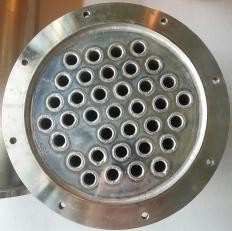
C: The split condenser and condenser are cooled by tubes. There are many tubes inside, with large heat exchange area and high cooling effect.
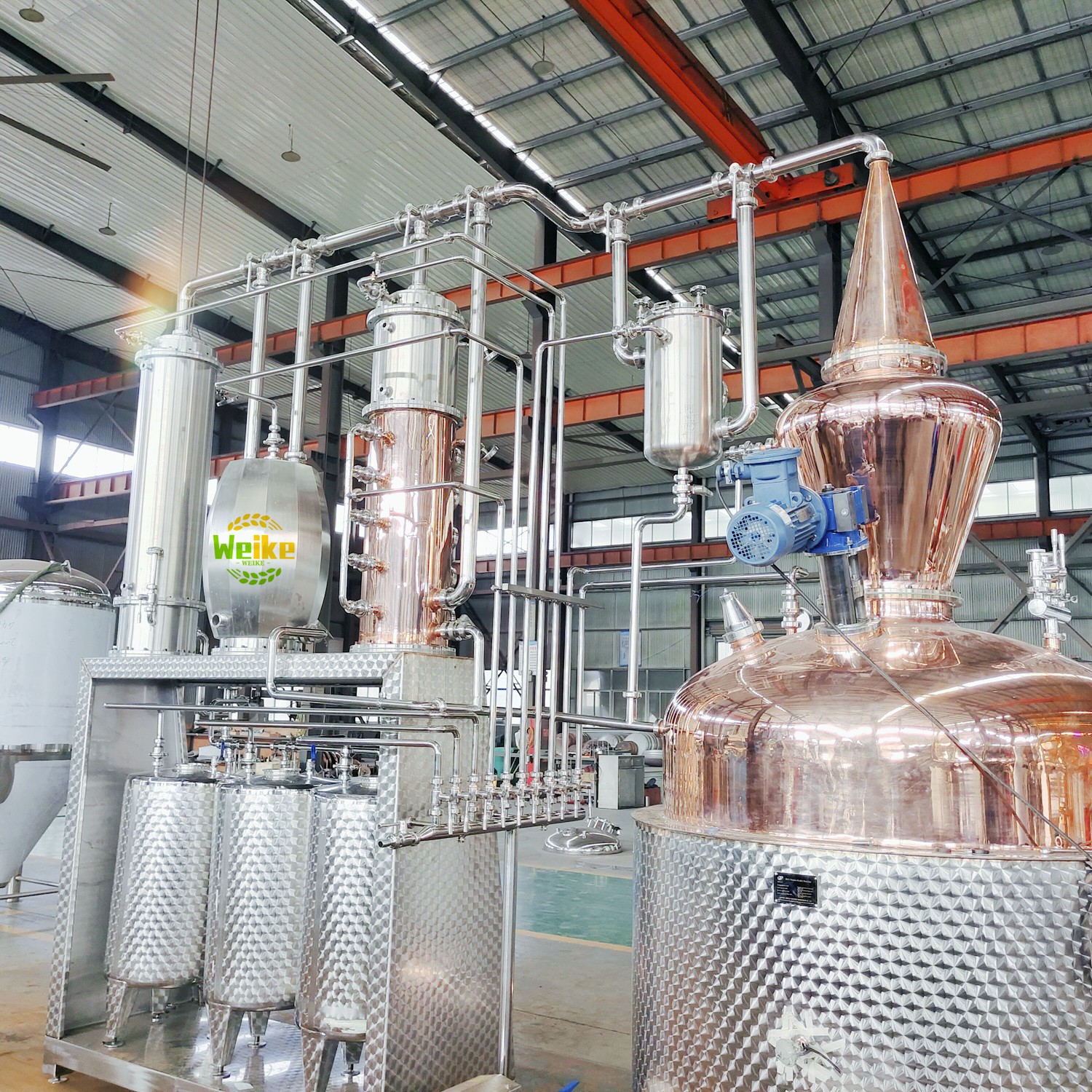
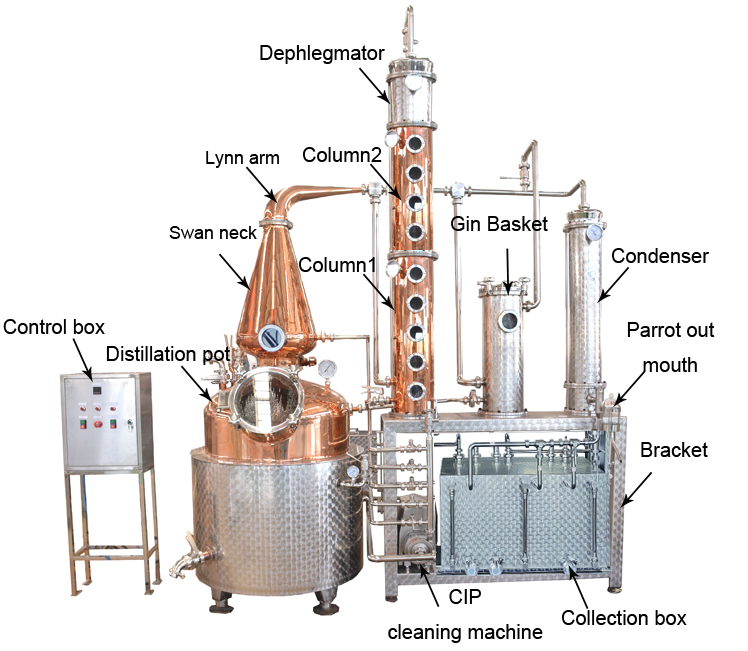
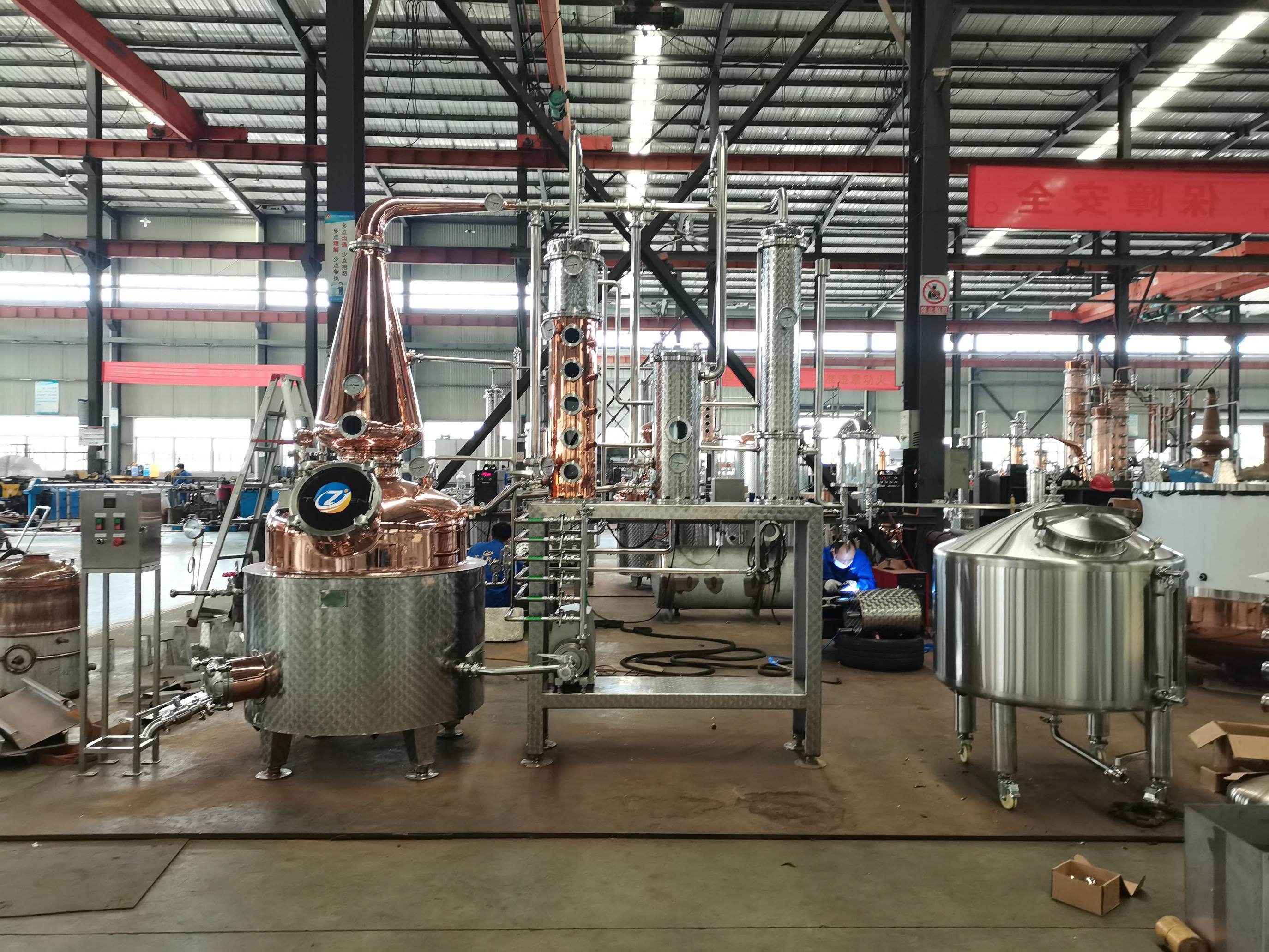
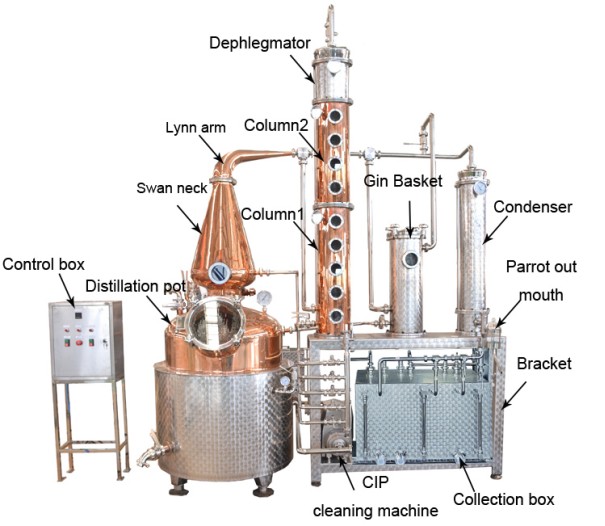
NO.3 Brief introduction of distillation equipment

NO.4 Technical parameters of 500L multifunctional distillation equipment
Name | Multifunctional Distillation pot |
Working volume | 500L |
Design volume | 700L |
Distillation mode | Tower distillation |
Distillation time | About 4-8 hours |
Heating | Heating mode | Steam jacket heating |
Heating area | 2.5㎡ |
Steam demand | 50KG/H |
Steam pressure | <0.1MPa |
Heating time | About 60 minutes |
Cooling mode | Ice water circulating cooling |
Area of cooling surface | 5.86㎡ |
Water demand | Maximum water demand 1.5T/H |
Overall power | 1.85KW |
Overall dimension | 3100mm*1400mm*3900mm |
Configuration and quotation of 500L distillation equipment
Best FOB Quote
NO. | Name | Explain | QTY | Remarks |
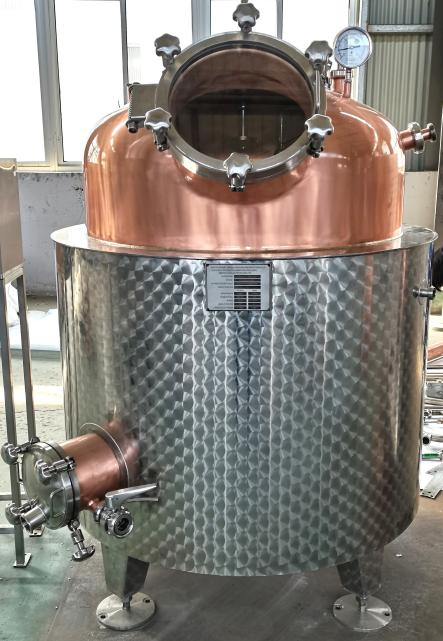
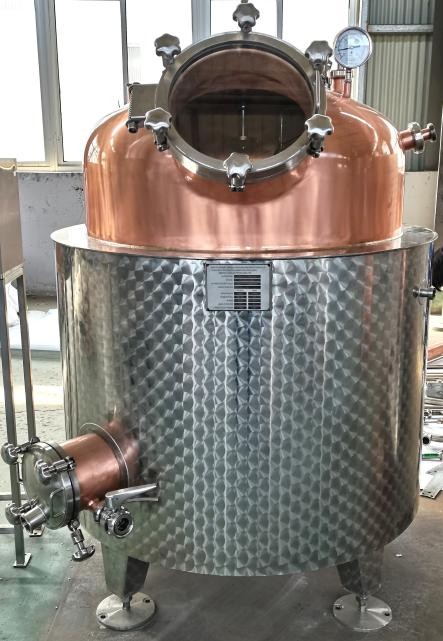
1 | 500L Distillation pot | 1. Volume: 500L (working volume) 700L(Design volume) 2. Material: TP2 red Copper & SUS304 stainless steel (copper inner tank , stainless steel heating layer and fishscale coating) 3.Style: three layer design, Steam heating(Jacket heating mode at the bottom and around), Including external insulation layer. 4. Material of insulation layer: aluminum silicate rock wool, high temperature resistant, fireproof material. 5.Heat exchange area: 2.5㎡ 6. Configuration: Full glass manway, Safety valve,Pressure gauge, Thermometer, PT100 temperature sensor, Ball valve, Blowdown valve, CIP cleaning ball, Motor mixing, Exciter lamp, Drain valve, Globe valve etc 7. Thickness: the thickness of TP2 red copper liner is 4mm, the thickness of heating laye is 4mm, and the outer casing is 2mm 8. Welding process: the connection between TP2 red copper and SUS304 stainless steel is welded by flanging technology | 1 | 
|
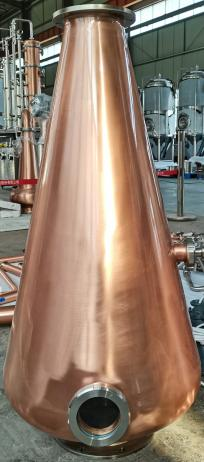
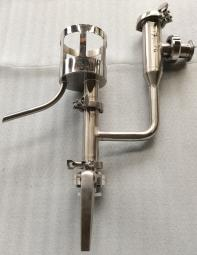
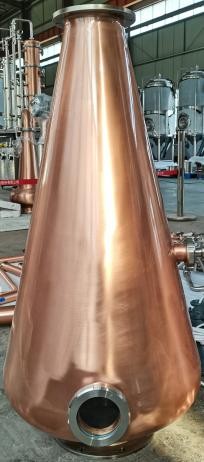
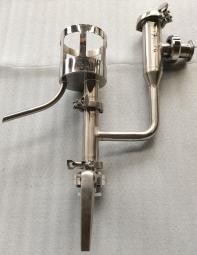
2 | Swan neck | 1. Material: TP2 red copper. 2. Thickness 3mm 3. Style: Lantern shaped 4. Standard configuration: Sight glass, CIP cleaning ball 5. Welding process: the connection between TP2 red copper and SUS304 stainless steel is welded by flanging technology | 1 | 
|
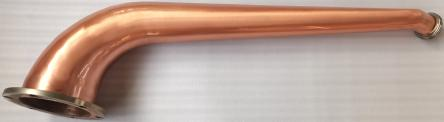
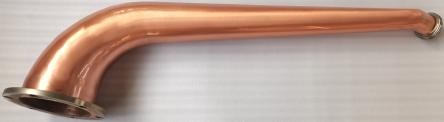
3 | Lyn arm | 1. Material: TP2 red copper. 2. Thickness 3mm 3. Angle: 100 degrees 4. Welding process: the connection between TP2 red copper and SUS304 stainless steel is welded by flanging technology | 1 | 
|
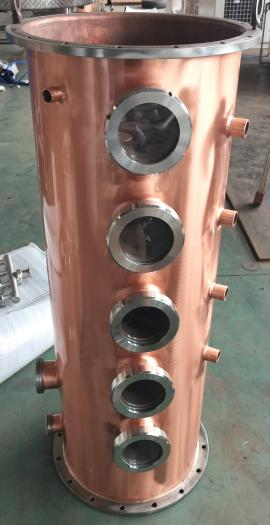
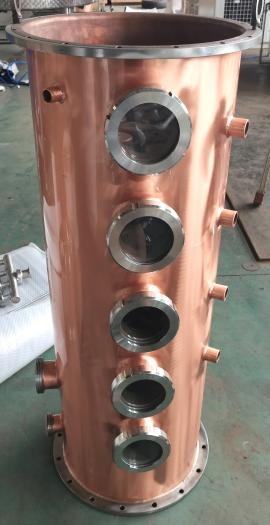
4 | Column | 1. Material: T2 red copper 2. Size: 12”(Φ300mm) 3. Thickness: 3mm (shell wall thickness) 4. Configuration: red copper clapboard and copper bubble cover are equipped inside, 4-layer diaphragm(Each floor is equipped with manual reflux device), 5 sight glass, the bottom layer is the reflux layer. Top equipped with thermometer, Each floor is equipped with CIP cleaning balls and Check valve 5. Welding process: the connection between TP2 red copper and SUS304 stainless steel is welded by flanging technology | 1 | 
|
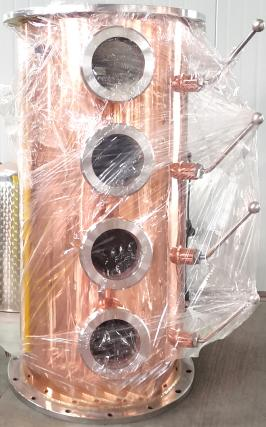
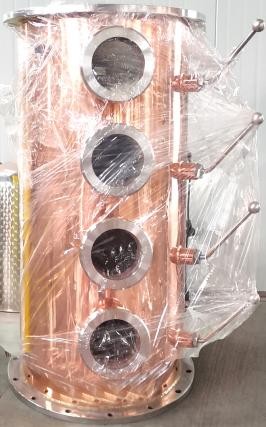
5 | Column | 3. Material: T2 red copper 4. Size: 12”(Φ300mm) 3. Thickness: 3mm (shell wall thickness) 4. Configuration: red copper clapboard and copper bubble cover are equipped inside, 4-layer diaphragm(Each floor is equipped with manual reflux device), 4 sight glass. Top equipped with thermometer, Each floor is equipped with CIP cleaning balls and Check valve 5. Welding process: the connection between TP2 red copper and SUS304 stainless steel is welded by flanging technology | 1 | 
|
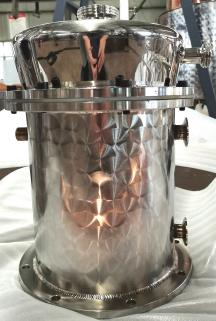
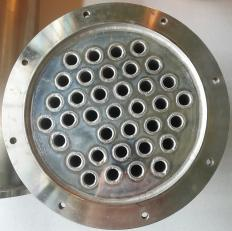
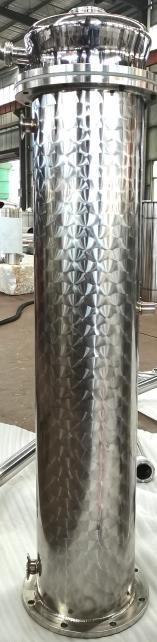
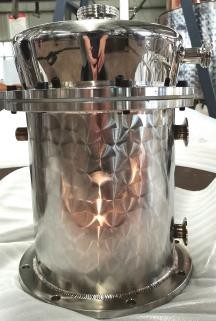
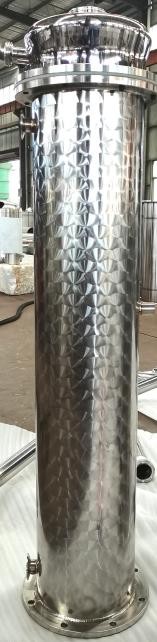
6 | Dephlegmator | 1.Material: SUS304 stainless steel 2.Size: 12”(Φ300mm) 3. Style: column type condensation (shell and tube type), there are 37 channels of SUS304 stainless steel tube inside 4.Area of cooling surface: 1.02㎡ 5. Configuration: Thermometer, crown cap and CIP cleaning ball 6. Thickness: shell thickness 3mm | 1 | 

|
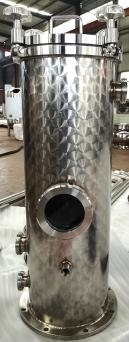
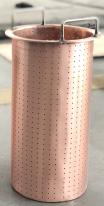
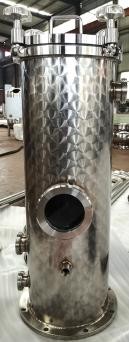
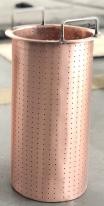
7 | Gin Basket | 1. Material: SUS304 stainless steel and TP2 red copper 2. Size:12”(Φ300mm) 3. Configuration: Sight glass, Built in:TP2 red copper hanging basket and CIP cleaning ball 4. Thickness:shell thickness 3mm | 1 | 

|
8 | Condenser | 1.Material: SUS304 stainless steel 2.Size: 10”(Φ250mm) 3. Style: column type condensation (shell and tube type), there are 154 channels of SUS304 stainless steel tube inside 4.Area of cooling surface: 4.84㎡ 5. Standard configuration: Thermometer and CIP cleaning ball 6. Thickness:shell thickness 3mm | 1 | 
|
9 | Mouth of wine | 1. Material: SUS304 Stainless steel and glass 2.Style: simple type, easy to observe the wine situation | 1 | 
|
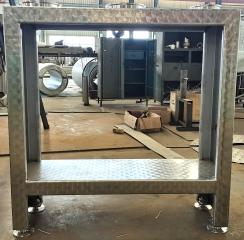
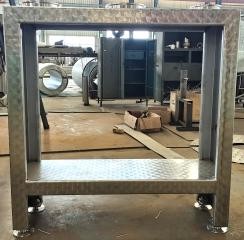
10 | Bracket | 1. Material: 304 stainless steel | 1 | 
|
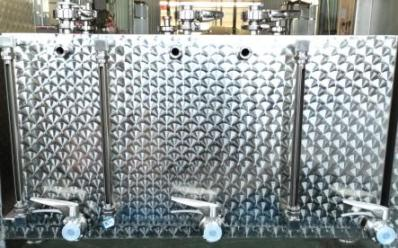
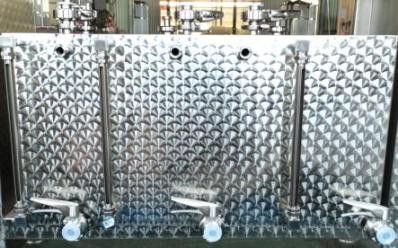
11 | Wine Collection box | 1. Material:SUS304 stainless steel 2. Thickness: 3mm 3. Function: Collect foreshore heads, middle cut heard, and faints tail 4. Configuration: 304 stainless steel duckbill butterfly valve, breathing valve, mirror, etc | 1 | 
|
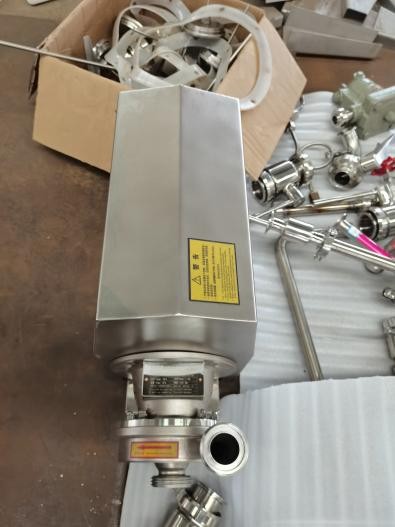
12 | CIP cleaning | 1. Material: 304 stainless steel 2. Power: 1.1KW (EX) 3. Function: used to clean Distillation pot, Swan neck, Column, Dephlegmator, Gin Basket and Condenser. 4. Configuration: stainless steel pipe and valve, each part can be controlled separately Cleaning | 1 | 
|
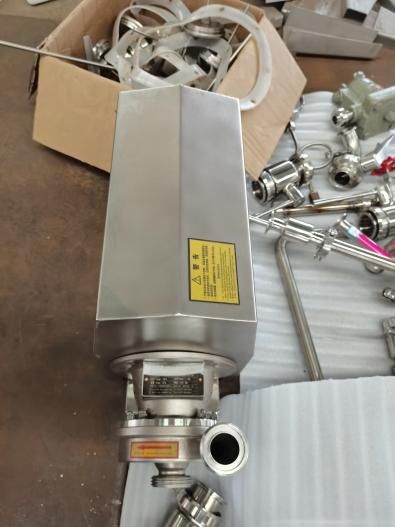
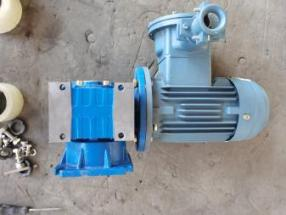
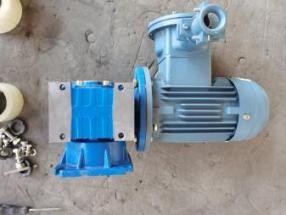
13 | Mixing motor | 1. Power: 0.75KW (EX) | 1 | 
|
14 | Control box | 1. Style: ordinary button type, 304 stainless steel shell 2. Function: control the switch of mixing motor and CIP cleaning pump, measure and display temperature, etc | 1 | 
|
15 | External surface treatment of red copper | 1. External surface treatment of red copper: mirror polishing or anti oxidation treatment 2. Standard configuration: Anti oxidation treatment, convenient for cleaning the outer surface of red copper, as it will oxidize when in contact with air or water. 3. Attention: If not required, please explain | 1 |
|